From Product Idea to First Production Run: A Realistic Private Label Supplement Timeline
-
 Yukang Medicine Content & Manufacturing Team
- 9th November 2026
From Product Idea to First Production Run
A realistic private label supplement timeline for brands, buyers, and product teams
Quick answer
A first private label supplement order does not begin when a factory starts production. It begins when a product idea becomes specific enough to make, pack, label, and approve. For a simple project with a clear brief and standard packaging, the process can move efficiently. For a custom formula, new flavor, unusual pack, or changing label direction, more time is normal. The practical question is not “How fast can this be made?” It is “What needs to be decided before the next step can start?”
This guide walks through the usual path from an idea to a first production run in plain language. It is written for supplement brand founders, distributors, Amazon and e-commerce teams, and buyers comparing private label, OEM, or ODM options.
Before the timeline starts what you actually need
You do not need a finished formula to start a useful conversation with a manufacturer. A reference product, a product category, a target customer, or an early packaging idea can be enough. What matters is being honest about what is decided and what is still open.

Early product review A clear brief gives a manufacturer something practical to assess.
At the very beginning, collect five simple pieces of information: the market you plan to sell in, the format you prefer, any ingredient or reference-product direction, the estimated first quantity, and the packaging look you have in mind. Those details allow a factory to give useful feedback rather than a vague price range.
YKNatura’s supplement product portfolio is a helpful starting point when you are comparing the formats available for a new private label project.
A realistic project timeline at a glance
The steps below can overlap, but they should not be confused. For example, artwork can begin while a sample is under review, but it should not go to print before the key product details are approved.
| Project stage | What happens | What the buyer should decide | What can add time |
| 1. Product brief | Define the commercial idea and target market. | Format, reference product, target quantity, price position. | No clear buyer, market, or product direction. |
| 2. Feasibility review | Check whether formula, serving size, format, and pack work together. | What is essential versus flexible. | Too many ingredients for the chosen format; late changes. |
| 3. Sample development | Prepare a version worth evaluating. | Formula direction, taste or appearance, count, bottle or pouch. | Trying to test several unrelated concepts in one sample. |
| 4. Approval and artwork | Confirm the approved product and prepare label and packaging. | Serving information, pack size, label content, artwork version. | Artwork starts before formula or packaging is stable. |
| 5. Bulk production | Produce, fill, pack, inspect, and prepare agreed records. | Final sign-off contacts, testing scope, shipping plan. | Packaging components or final approval not ready. |
| 6. Delivery and review | Arrange delivery and document lessons for the next order. | Freight plan, receiving checks, reorder notes. | No clear destination or handoff plan. |
Stage 1 Turn the idea into a short product brief
A product brief is not a complicated technical document. It is a one-page explanation of what you want to launch and why. It keeps the early discussion focused. A good brief says who the product is for, where it will be sold, what format seems right, how it should be packed, and what scale you have in mind for the first run.
For example, “We want a consumer-friendly probiotic product for U.S. e-commerce, in a pectin gummy or powder stick format, packed for a first order of around 3,000 units” is a workable starting point. It is much easier to evaluate than “We need a wellness product.”
If the project may work better as a chewable product, review private label gummies. If a scoop, jar, sachet, or stick pack is more relevant, review the powder supplement range. The aim is not to copy an existing product; it is to give the project a practical starting point.
Stage 2 Make sure the idea can work in real life
This is where a factory looks at the idea as a finished item rather than a marketing concept. Can the intended amount fit into the selected capsule? Will a powder have a practical serving size? Does a liquid need a particular bottle or closure? Can the selected packaging protect the product as intended?
A feasibility review is useful because it surfaces tradeoffs early. A brand may decide that a capsule is more practical than a gummy for a certain ingredient amount, or that a stick pack makes more sense than a large jar for the target customer. These are not setbacks. They are the decisions that make later samples and quotes more reliable.
For oil-based or liquid-filled concepts, the softgel supplement category may be a useful comparison point. For measured liquid products, see the liquid drops category and consider the bottle, dropper, serving amount, and label together.
Stage 3 Use samples to answer real questions
A sample is not simply a free-standing “preview.” It is a decision point. The sample should help the buyer confirm the things that will carry into bulk production. For gummies, that can include flavor, texture, shape, count, and bottle. For powders, it can include taste, mixing experience, serving format, and pack type. For capsules, it can include shell type, fill amount, capsule count, and bottle choice.
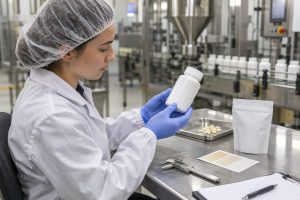
Sample and quality review The purpose of a sample is to make clear, recorded decisions before bulk production.
The fastest sample process is not always the one with the fewest days. It is the one with focused feedback. If you want to compare two flavors, say that before the sample is prepared. If you want a benchmark matched as closely as possible, say which attributes cannot change. Once feedback arrives, document the approved version rather than relying on memory or chat messages.
Stage 4 Treat formula and packaging as one decision
Many first-time projects slow down here. The formula may be close to approved, but the bottle count changes. Or a carton design is ready, but the final serving size changes. Or a product was planned in a pouch, then a bottle is preferred. Each change can affect artwork, packing, sourcing, and sometimes the production plan.
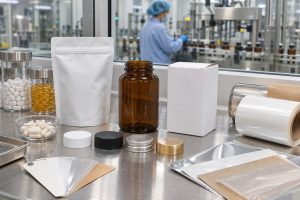
Packaging planning Product format, bottle or pouch choice, and label artwork need to stay aligned.
Before artwork goes to print, confirm the product name, serving size, count or net quantity, ingredient information, packaging component, and destination-market requirements. Buyers should also decide who has authority to give the final approval. This avoids a common problem: a supplier asks a simple approval question, but the project pauses because several stakeholders give different answers.
For a closer look at why liquid formula and packaging need to be reviewed together, read YKNatura’s private label liquid supplement manufacturing guide.
Stage 5 Lock the version that goes into production
Production should begin with one stable version of the project. That means the buyer and manufacturer agree on the formula direction, serving size, packaging components, label artwork, quantity, and agreed testing or documentation scope. The purpose is not to remove flexibility forever. It is to make the first run repeatable.
This is also the best time to compare quotations properly. A lower price only means something when the formula, ingredient grade, serving size, bottle count, packaging, and testing scope are the same. If two quotes are built on different assumptions, they are not a real comparison.
Before production, confirm the simple handoff details: who receives production updates, who approves final artwork, which freight arrangement will be used, and what information is needed at destination. This is especially important for new brands using a 3PL, Amazon prep service, distributor warehouse, or nominated freight forwarder.
Stage 6 Production, inspection, and what happens next
During bulk production, the work moves from testing an idea to repeating an approved specification. The factory prepares the formula, fills or forms the product, applies the selected packaging, performs the agreed checks, and prepares the records included in the project scope. The buyer should stay available for any last operational question, but the major decisions should already be closed.
After delivery, take notes. Did the packaging arrive as expected? Was the product easy for the warehouse to receive? Did the first order reveal a better count, pack format, or ordering schedule? These notes are valuable because the second order is where a brand can improve efficiency without reopening the whole project.
What usually causes unnecessary delays
- Changing the serving size after label artwork has already been drafted.
- Changing the bottle, pouch, or carton after its dimensions have been used for design.
- Asking for several different formula directions without defining what the sample needs to prove.
- Waiting until the end to name the destination market or the required documentation.
- Comparing prices when each supplier is quoting a different product specification.
- Leaving final approval with no clear decision-maker on the buyer side.
A buyer checklist before requesting a quote
You do not need perfect answers to every question. But the more of these you can share, the more useful the first quote and manufacturing review will be.
| Send this information | Why it matters |
| Target market and sales channel | Affects label review, product direction, and project planning. |
| Product idea or reference product | Gives the manufacturer a clear starting point. |
| Preferred format | Helps identify practical serving and packaging choices. |
| Estimated first order quantity | Allows an MOQ and packaging discussion built around your scale. |
| Packaging direction | Prevents a formula quote from being mistaken for a finished-pack quote. |
| Target launch timing | Helps identify approvals and custom components that need early attention. |
Frequently asked questions
Can I begin without a final formula?
Yes. A formula, reference item, ingredient direction, or product idea can start a feasibility discussion. Before samples and bulk production are approved, the project needs a more defined version.
How long does a first private label supplement project take?
There is no honest one-size-fits-all number. The timeline depends on how ready the brief is, whether the formula is established or custom, how quickly samples and artwork are approved, and whether custom packaging components are needed. A clear approval process usually makes more difference than trying to rush the factory.
What is a good first order quantity?
The right first quantity depends on format, ingredients, packaging, sales channel, and budget. YKNatura publishes projects starting from 1,000 units for many product types, but the final MOQ should always be confirmed against the actual specification.
Do I need a final bottle and label before asking for a quote?
No. A packaging direction is enough at the beginning. However, the final bottle, count, label artwork, and carton need to be approved before production can proceed smoothly.
Start with the details you already have
A good first conversation does not require a finished technical brief. If you have a product concept, a reference product, a draft formula, or an initial packaging idea, share it. YKNatura supports private label, OEM, and ODM supplement projects across capsules, gummies, powders, tablets, softgels, and liquids for global brands, distributors, and e-commerce businesses.
Explore current supplement formats or request a manufacturing review. For a faster discussion, include the target market, preferred format, estimated quantity, and any product reference you have.
Yukang Medicine Content & Manufacturing Team
Latest Supplement Manufacturing Insights