Top Dietary Supplement Formulation Trends for Brand Owners
-
 Yukang Medicine Content & Manufacturing Team
- 25th August 2026

Formulation starts with the target customer, a clear product brief, and ingredients that suit the chosen format.
Article at a glance
| For brand owners | What this guide covers |
| Private label and OEM buyers | The formulation choices shaping supplement projects in 2026 |
| Product developers | How to select ingredients, dosage forms, packaging, and claims in the right order |
| Procurement and sourcing teams | The questions to settle before requesting a quote or approving a pilot batch |
What this article is about
Supplement formulation trends are often discussed as a list of fashionable ingredients. That is not how strong products are built. For a brand owner, a useful trend is one that can be turned into a clear product proposition, a sensible delivery format, a realistic specification, and compliant market communication. This guide looks at the decisions that sit behind those outcomes.
The 2026 market rewards products that are easier to understand and easier to trust. Recent consumer research from the Council for Responsible Nutrition found that scientific evidence, transparency, and independent quality verification matter to buyers. That does not mean every label needs more ingredients or a bigger claim. It means the formula, format, and label should tell one coherent story.
1. Focused formulas are replacing broad ingredient lists
A generic “everything in one bottle” concept can be difficult to explain and even harder to formulate well. Brands are instead building around a defined use occasion, customer profile, or routine. That may be a daily mineral format, a beauty-oriented gummy, a women’s microbiome formula, or a hydration stick pack. The commercial advantage is clarity: the product has an obvious place in a customer’s routine and a cleaner message for product pages, ads, and retail conversations.
Focused does not mean making a disease claim. In the United States, claims need to be truthful, non-misleading, and appropriately substantiated. A structure/function claim must not name a specific disease, and marketers should ensure the evidence relates to the finished product and the exact claim being used. Build the claims review into the formulation brief, not after label design is complete.
For projects in capsule format, see our private label capsule manufacturing options. For a broader starting point, explore YKNatura’s OEM and ODM supplement services.
2. Clean label now means a clearer explanation, not a vague badge
“Clean label” still has no single legal definition, so it should not be used as a shortcut for quality. In practice, buyers commonly interpret it as a shorter, more recognizable ingredient list, fewer avoidable additives, and transparent sourcing or processing choices. That expectation affects both the active ingredients and the supporting system: sweeteners in gummies, carriers in powders, capsule shells, colors, flavors, and preservatives where relevant.
The formulation question is not simply “Can we remove this excipient?” It is “What happens to taste, flow, stability, appearance, cost, and shelf life if we do?” A responsible development process evaluates those trade-offs before a commercial quote. If an ingredient is removed, the replacement must still allow the product to be manufactured consistently and to meet its agreed specification.
3. Delivery format is part of the formulation
The same ingredient concept can behave very differently as a capsule, gummy, powder, liquid, softgel, chewable tablet, or effervescent format. A powder may make sense when the intended serving is large. A capsule can be a practical choice for a compact formula. Gummies bring a familiar consumer experience but require careful work on taste, texture, sugar system, and active loading. Liquids and drops may suit a low-volume serving but introduce their own stability and packaging considerations.

Capsules, powders, drops, gummies, and effervescent tablets have different formulation and packaging constraints.
Do not select the format solely because it is popular. Ask how the customer will use the product, what daily dose must be delivered, what sensory experience is acceptable, and how the formula will travel through manufacturing and distribution. Manufacturing trend reports continue to highlight alternative formats such as stick packs, melts, liquids, gummies, and effervescent tablets, but the right answer depends on the brief—not the trend cycle.
If your concept is designed for a chewable format, review our private label gummy supplement options. For products intended for convenient measured servings, consider our private label liquid drops capabilities or powder supplement manufacturing.
4. Formulation feasibility should be checked before packaging design
Many projects lose time because the brief begins with a label look and ends with a difficult formula. A better sequence is: define the audience and market, choose the delivery format, establish the target actives and serving size, assess feasibility, then move into packaging and label content. This reduces late-stage changes caused by fill weight, tablet size, flavor masking, settling, moisture control, or incompatibility between ingredients.
For example, a formula may look simple on paper but still need process development because it has poor powder flow, a strong taste, low solubility, or sensitivity to humidity. These are not reasons to abandon an idea. They are reasons to test the concept early and agree on what “acceptable” means for the finished product.
5. Traceability and documentation are becoming part of the brand proposition
Trust is increasingly built through practical proof: accurate specifications, supplier documents, batch records, appropriate testing, and labels that consumers can read. The U.S. dietary supplement CGMP rule requires firms that manufacture, package, label, or hold supplements to establish and follow current good manufacturing practices. For brands, that translates into a practical supplier-evaluation question: how does the manufacturer control identity, specifications, packaging, labeling, and records for the product you plan to sell?

Quality planning should connect ingredient specifications, manufacturing controls, finished-product checks, and labeling.
When an ingredient is novel or its regulatory status is uncertain, do not treat it as a standard sourcing decision. In the U.S., a manufacturer or distributor may need to submit a New Dietary Ingredient Notification at least 75 days before introducing an applicable product into interstate commerce. Regulatory requirements also vary by market. Brands should seek qualified regulatory advice for their target country before commercial launch.
6. Sensible customization is more valuable than unnecessary complexity
Customization can create a real point of difference when it serves a customer need: a suitable dose, format, flavor profile, packaging size, or ingredient strategy. It becomes less useful when it adds complexity without a clear benefit. More ingredients can increase sourcing risk, testing needs, costs, label crowding, and manufacturing uncertainty. A concise formula with well-defined specifications is often easier to explain and scale than an overloaded blend.
Before approving development, document the non-negotiables. These usually include the target market, intended customer, finished format, serving size, active ingredients and forms, required exclusions, flavor direction, packaging, label claims, forecast volume, and target launch window. A good manufacturer can then assess options against the same brief rather than making assumptions one email at a time.
A practical formulation brief for brand owners
- Commercial goal: What customer need or routine is the product designed for?
- Target market: Where will the product be sold, and which labeling rules apply?
- Format: Capsule, gummy, powder, liquid, softgel, tablet, or effervescent product?
- Formula targets: Ingredient forms, serving size, intended dose, and exclusions.
- Consumer experience: Flavor, sweetness, swallowability, mixability, or texture requirements.
- Packaging: Bottle, pouch, sachet, tube, dropper, or other format; label and carton needs.
- Project economics: Trial quantity, planned order quantity, and desired delivery timing.
- Evidence and claims: The claim language you want to use and the substantiation or review needed.
How YKNatura supports formulation projects
YKNatura works with supplement brands on OEM, ODM, and private label projects across capsules, gummies, powders, tablets, softgels, liquid drops, and liquid supplements. The first step is not to force every idea into a stock formula. It is to evaluate whether the requested ingredients, dosage form, packaging, target quantity, and market requirements can work together.
When you are ready to discuss a project, request a quote from YKNatura and include your formula, a reference sample, or even an early product idea. The more complete the brief, the faster a manufacturer can recommend a realistic next step.
Frequently asked questions
What is the most important supplement formulation trend for a new brand?
The most useful trend is not a particular ingredient. It is creating a product with a focused purpose, a suitable delivery format, and language consumers can understand. That combination makes the product easier to position, manufacture, and communicate responsibly.
Should a brand start with a custom formula or a stock formula?
It depends on the commercial goal. A stock or established formula can help reduce development time when it fits the brand strategy. A custom formula may be a better route when differentiation, ingredient selection, format, or market positioning requires it. Both options still need a feasibility and compliance review.
Can a manufacturer guarantee that a supplement claim is compliant?
A manufacturer can help identify technical and labeling considerations, but the brand owner remains responsible for marketing decisions in its target market. Claims should be reviewed against applicable requirements and supported by appropriate evidence. Qualified regulatory counsel may be needed for complex projects.
How early should packaging be discussed?
Discuss the intended packaging early, but finalize artwork after the formula and format specifications are settled. Packaging affects protection, fill volume, label space, shipping, and user experience.
Yukang Medicine Content & Manufacturing Team
Latest Supplement Manufacturing Insights
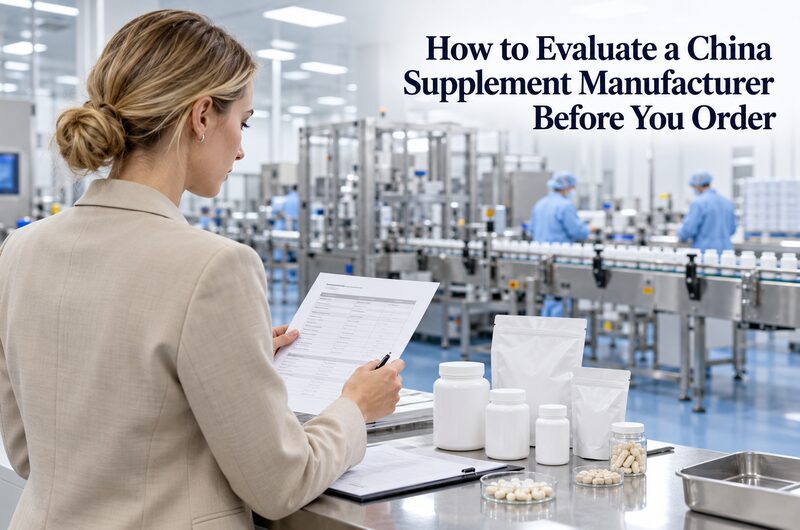
How to Evaluate a China Supplement Manufacturer Before You Order

Capsules Gummies Powders and Softgels Guide for Supplement Brands