How Long Does Private Label Supplement Manufacturing Take? From Sample to Bulk Production
-
 Yukang Medicine Content & Manufacturing Team
- 28th October 2026
Executive Answer
Private label supplement manufacturing does not have one universal lead time. The timeline depends on the route you choose: an established formula under your brand, an OEM project built from your specification, or an ODM project that begins with a product concept. For powder and liquid supplements, the visible production run is only one part of the schedule. Sample review, label approval, material and packaging preparation, production planning, in-process checks, final release, and shipping all affect the finished delivery date.
At YKNatura, project planning starts with the information that makes a timeline meaningful: product format, target market, formula status, packaging direction, expected quantity, and requested delivery point. A standard production reference may be around 15 days after final requirements are confirmed for suitable projects, but that is not the same as the total project timeline and is not a fixed delivery promise.
At a Glance: The Three Project Routes
| Project route | Typical starting point | What can shorten or extend the schedule |
| Private label | An established formula with your label or packaging direction. | Less early formulation work; label, packaging, quantity, and production-slot confirmation still matter. |
| OEM | You provide a developed formula, specification, or reference sample. | The schedule depends on formula review, material availability, package compatibility, and agreed documentation. |
| ODM / custom project | You have a product goal but need development support. | Samples, revisions, feasibility checks, packaging selection, and approvals add planning time. |
What “Lead Time” Actually Includes
International buyers often ask, “How many days is production?” The better question is, “What is included before a product is ready to ship?” Separating the milestones helps prevent a production date from being mistaken for a delivery date.
| Term | Meaning for a supplement project |
| Project lead time | The end-to-end period from the first project brief to goods ready for collection or dispatch. |
| Production lead time | The period after required approvals, materials, packaging, and production planning are in place. |
| Quality release | The review and release activities required before a batch is treated as ready for shipment. |
| Transit time | The period after dispatch; it depends on destination, shipping method, customs, and the receiving process. |
| REAL PHOTO PLACEMENT
Project planning and production readiness Use YKNatura original asset: A YKNatura R&D or manufacturing-team image from the homepage asset library Recommended ALT text: YKNatura supplement manufacturing team reviewing a private label project before bulk production |
Figure suggestion: use an original factory photograph rather than a stock or AI-generated production image. Keep the caption descriptive, not promotional.
Step 1: Define the Product Brief
A reliable timeline starts with a clear project brief. You do not need a finished formula to contact a manufacturer, but the more precisely the project is defined, the more useful the first timeline will be. For a powder or liquid supplement, the brief should identify the target market, intended consumer, product format, preferred packaging, estimated quantity, target launch date, and any ingredient or flavour preferences.
For example, “a hydration powder for online sales in the UK” is a useful starting point, but it still needs decisions about serving size, stick packs or tubs, flavour profile, ingredient specifications, and label requirements. For a liquid project, bottle size, cap or dropper style, liquid appearance, and packaging configuration also need to be discussed.
If you are still deciding between formats, review YKNatura’s private label powder supplement options and private label liquid supplement options.
Step 2: Formula Review or Product Development
The next stage depends on what you already have. An established private-label formula may move directly into specification, packaging, and production planning. An OEM project may begin with a buyer-provided formula or reference sample. An ODM project may require a more structured review of the product concept, ingredient options, serving profile, flavour, and manufacturing feasibility.
This stage is particularly important for powders and liquids because the delivery format affects what is practical. Powder projects can involve questions about flavour, dispersibility, powder flow, fill accuracy, and whether a tub, sachet, or stick pack is appropriate. Liquid projects can involve questions about bottle and closure compatibility, flavour, appearance, fill volume, and packaging configuration. The objective is not to promise that every concept can be produced exactly as imagined; it is to identify a technically and commercially workable route before bulk production is planned.
For a plain-language comparison of project models, see YKNatura’s Private Label vs. Custom Manufacturing OEM/ODM Guide.
Step 3: Sample Review and Approval
A sample is a decision tool, not a bulk-production batch. It allows the brand and manufacturer to confirm the product direction before larger commitments are made. For powder projects, sample review may cover taste, aroma, colour, solubility, powder condition, and serving experience. For liquids, it may cover taste, appearance, bottle presentation, and the intended consumer experience.
A clear feedback process keeps this stage moving. Consolidate comments from internal stakeholders into one response, identify which points are essential versus optional, and confirm whether a revision affects only flavour or also the specification, packaging, or product claim language. Multiple sample rounds are sometimes appropriate, but each additional change can affect the project schedule.
Step 4: Packaging, Artwork, and Label Approval
Formula work and packaging work should move in parallel whenever possible. Waiting until a sample is approved before beginning packaging discussions can create an avoidable gap. Powder and liquid projects need a confirmed packaging direction: for example, a tub, sachet, bottle, dropper bottle, cap, label, carton, or secondary pack.
Before production, the approved artwork and the approved product specification must point to the same product. The label should accurately reflect the final ingredient and serving information, net contents, packaging configuration, and market-specific requirements. The brand remains responsible for confirming that claims and label content are suitable for the intended market. A manufacturing site should not be expected to treat generic wording as a universal compliance approval.
For liquid formats such as dropper bottles, see YKNatura’s private label liquid drops page.
| REAL PHOTO PLACEMENT
Packaging and artwork approval Use YKNatura original asset: Use a real YKNatura product-label proof, sample bottle, or packaging review image Recommended ALT text: Supplement packaging artwork and bottle configuration reviewed before private label production |
Figure suggestion: use an original factory photograph rather than a stock or AI-generated production image. Keep the caption descriptive, not promotional.
Step 5: Prepare Materials and Packaging Components
A material arriving at the factory is not automatically ready for use. Before production is scheduled, ingredient and packaging information must be checked against the approved project requirements. Depending on the project, this may include the material name, specification, lot information, packaging version, and supporting documentation. If information does not match the project requirement, the right response is to pause, identify the affected material or component, and clarify the facts before it enters production.
This is one reason a published “production time” cannot describe every project. A project can be mechanically simple but still require planning time if an ingredient, bottle, label, carton, or other component is not ready. Confirming material and packaging readiness early gives both the brand and the manufacturer a more credible schedule.
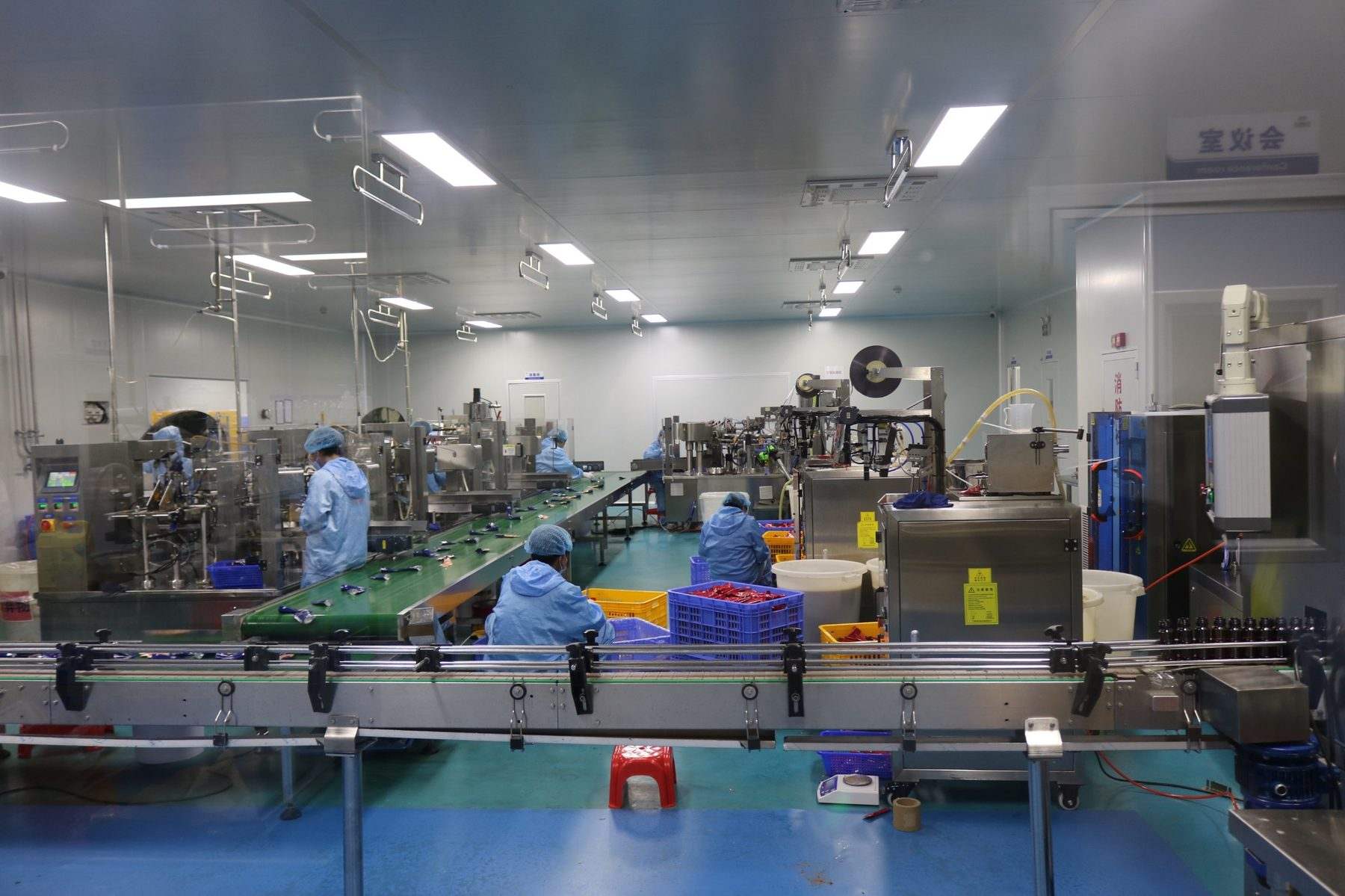
Step 6: Bulk Manufacturing and In-Process Checks
Once the approved formula or specification, packaging, materials, and production plan are in place, the bulk manufacturing stage can begin. The exact process differs by format and project. The table below describes common control points; it is not a claim that every project follows an identical sequence.
| Powder supplement project | Liquid supplement project |
| Incoming material and project-information confirmation | Incoming material and project-information confirmation |
| Weighing and material addition | Liquid preparation and filling readiness |
| Blending, flow, and fill preparation | Filling volume, closure, and bottle-handling checks |
| Filling into tubs, sachets, or stick packs | Filling into bottles or dropper configurations |
| Packaging, appearance, and project-specific checks | Packaging, appearance, and project-specific checks |
The most useful way to discuss production with a manufacturer is not “Do you have a machine?” but “What is checked before, during, and after this operation for my project?” That question creates a more practical conversation about specifications, packaging, expected documents, and communication responsibilities.
| REAL PHOTO PLACEMENT
Bulk production in action Use YKNatura original asset: Use an original YKNatura image of mixing equipment, a powder line, or a liquid filling line Recommended ALT text: Powder blending or liquid filling operation during private label supplement bulk production |
Figure suggestion: use an original factory photograph rather than a stock or AI-generated production image. Keep the caption descriptive, not promotional.
Step 7: Final Review, Release, and Shipment Preparation
Manufacturing completion and shipment readiness are different milestones. Before dispatch, the finished product, packaging, project records, and agreed release requirements need to be addressed. The final stage may also include outer-carton confirmation, shipping marks, pallet or export preparation, and communication with the receiving warehouse or freight partner.
For this reason, build your product-launch plan backward from the required delivery date, not forward from the day you request a quotation. Leave time for receiving, fulfilment-centre intake, customs where applicable, and any final marketplace or retail preparation.
Planning Timeline: What to Expect
The table below is designed for planning conversations. It deliberately separates milestones instead of presenting one unsupported “total lead time.” YKNatura’s public planning reference indicates samples around 7–10 days for suitable projects and standard production around 15 days after final requirements are confirmed; special packaging can extend production planning. Exact timing must be confirmed against the product, order, materials, packaging, schedule, and destination.
| Milestone | Established private label | OEM or custom project | What affects the timing |
| Project brief and quotation | Usually shorter when scope is clear | May require more technical discussion | Format, market, quantity, and packaging direction |
| Formula and sample | May be reduced for established formulas | Can require development and revision rounds | Formula status, flavour, feasibility, feedback speed |
| Artwork and packaging approval | Required before production | Required before production | Artwork readiness, component sourcing, label confirmation |
| Materials and production planning | Project-specific | Project-specific | Ingredient and packaging availability, production schedule |
| Bulk production | Confirmed after final approvals | Confirmed after final approvals | Format, order volume, special processing, packaging |
| Release, dispatch, and transit | Project-specific | Project-specific | Agreed requirements, shipping method, destination, customs |
What Can Extend a Manufacturing Timeline?
| Common situation | What the brand can do | What the manufacturer should do |
| The product brief changes repeatedly | Nominate one decision owner and consolidate feedback. | Explain which changes affect samples, packaging, or production planning. |
| Packaging files are not final | Begin artwork discussion early and provide editable files where appropriate. | Provide confirmed package dimensions, file requirements, and approval checkpoints. |
| Sample feedback is delayed | Set internal review deadlines for each sample round. | Document the revision request and clarify whether it affects the specification. |
| A material or component needs confirmation | Share requirements early and discuss acceptable alternatives where appropriate. | Check against approved project information and communicate any issue promptly. |
| A seasonal launch has a fixed date | Work backward from the launch date and include a buffer. | Discuss realistic production windows rather than promising an unsupported rush date. |
How to Move Faster Without Rushing Critical Steps
- Start with a one-page product brief: target market, format, product direction, packaging, quantity, and launch target.
- Choose powder or liquid early enough to let packaging and formula discussions progress together.
- Keep sample feedback consolidated and version-controlled.
- Confirm the final artwork before production planning is expected to begin.
- Ask which approvals, materials, and documents must be complete before the production clock starts.
- Plan reorders before inventory reaches a critical level; repeat production may skip some first-project decisions but still needs confirmed specifications and scheduling.
How YKNatura Supports Powder and Liquid Projects
YKNatura supports private-label, OEM, and ODM supplement projects for global brands, including powder and liquid formats. According to company-provided information, the Guangzhou facility supports formulation discussion, sampling, filling, labelling, packaging, and bulk production. The most useful starting point is a project conversation based on the real product requirement—not a generic promise of a fixed lead time.
Learn more about the YKNatura manufacturing facility and company background, or explore the supplement product-format pages before requesting a project review.
Frequently Asked Questions
How long does private label supplement manufacturing take?
It depends on whether the project uses an established formula, a buyer-provided specification, or a custom development route. A meaningful timeline includes sample and artwork approval, material and packaging preparation, production planning, bulk manufacturing, release, and transit—not only the machine running time.
Can I start a supplement project without a finished formula?
Yes. A product brief can be enough to begin a planning discussion. Share the target market, format, product direction, packaging preference, quantity, and target launch date. The next step is to determine whether an established option, an OEM specification, or an ODM route is appropriate.
When does the production lead time begin?
Ask the manufacturer to define this in writing. For a project to enter production planning, formula or specification approval, artwork approval, material and packaging readiness, order confirmation, and production scheduling may all need to be complete.
Why is a first order usually slower than a reorder?
A first order often includes decisions that a repeat order can reuse: formula or specification review, samples, artwork approval, packaging set-up, and initial sourcing. A reorder still requires confirmation of the approved specification, material availability, production scheduling, and shipping plan.
Can packaging design and sample development happen at the same time?
Usually, yes. Running these discussions in parallel can reduce avoidable waiting time, provided that the final artwork is not approved until the product and packaging configuration are confirmed.
What information should I send when requesting a quote?
Share your target market, product format, ingredient or formula status, preferred packaging, estimated quantity, target launch date, and destination. If you have a reference sample, specification sheet, or existing artwork, mention it in the initial brief.
Plan Your Project with a Clear Timeline
Planning a powder or liquid supplement project? Send YKNatura your target market, product format, packaging direction, expected quantity, and whether you have a formula, reference sample, or early-stage product concept. We can help map the production route and discuss a project-specific timeline.
Start with a project enquiry or explore powder supplement manufacturing and liquid supplement manufacturing options.
Editorial Notes and Reference Links
Content purpose: an educational planning guide for international supplement brands evaluating powder and liquid private-label, OEM, or ODM projects. Company figures and planning references are presented as company-provided information and should be confirmed for each project. This article does not provide legal, regulatory, medical, or market-specific compliance advice.
Related reference: YKNatura Private Label vs. Custom Manufacturing OEM/ODM Guide. Official U.S. manufacturing context: 21 CFR Part 111 dietary supplement cGMP regulations.
Yukang Medicine Content & Manufacturing Team
Latest Supplement Manufacturing Insights
How to Evaluate a China Supplement Manufacturer Before You Order
Capsules Gummies Powders and Softgels Guide for Supplement Brands