Capsule Size and Fill Weight Guide for Supplement Brands
-
 Yukang Medicine Content & Manufacturing Team
- 12th November 2026

Real capsule production-line photo from YKNatura. A capsule size is confirmed against the actual blend and sample—not guessed from an ingredient name.
| The short answer
A capsule number describes physical volume, not a fixed milligram capacity. A #00 filled with a light botanical powder can hold far less than the same #00 filled with a dense mineral blend. Start with the full daily serving, then test whether the real blend fits in a capsule size and capsule count your customer will accept. |
Why “500 mg” does not tell you the right capsule size
It is tempting to begin with a question such as, “Can this go into a #0?” The better first question is, “How much room does the entire finished blend take up?” A capsule is a small container with a defined internal volume. Milligrams tell you weight. The missing piece is how tightly the powder occupies that volume.
Think of it like a box of feathers and a box of sand. The boxes can be the same size, but the contents will not weigh the same. Capsule filling works the same way. Two formulas with the same label dose may require different capsule sizes—or different numbers of capsules per serving—because their powders behave differently.
For a private-label project, the goal is not to choose the biggest shell that might work. It is to land on a fill plan that is realistic to manufacture, clear on the label, comfortable enough for the intended customer, and appropriate for the bottle or pouch. That conversation normally starts with the private label capsule manufacturing category, then moves to the formula and sample.
The simple calculation behind capsule fill weight
| Planning formula
Estimated fill weight = capsule internal volume × the packed density of the finished blend. The word “packed” matters: the way a powder settles during production can be different from the way it looks in a scoop or bag. |
This calculation is useful for early planning, but it is not a production approval. Ingredient particle size, flow, moisture sensitivity, excipients, filling settings and the exact shell all affect the final result. A manufacturer should use the actual formula and a sample trial to confirm the finished capsule.
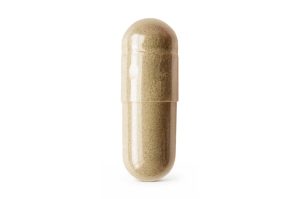
A hard capsule holds a set amount of volume. The weight it carries changes with the blend inside it.
Capsule sizes at a glance
The table below is a practical planning view for common adult hard-capsule sizes. Volumes are nominal and can vary slightly by shell supplier. The numbers help scope a project; they do not replace a filling trial.
| Capsule size | Nominal internal volume | When a brand may consider it | What still needs checking |
| #00 | About 0.90 mL | A higher single-capsule fill or a larger daily serving. | The blend may still need two capsules if it is light or bulky. |
| #0 | About 0.68 mL | A common adult format for many moderate fills. | Actual density can move a formula up or down a size. |
| #1 | About 0.48–0.50 mL | A moderate fill where a smaller shell is part of the brief. | A two-capsule serving may be more practical than forcing one larger dose. |
| #2 | About 0.36–0.37 mL | Lower-dose formulas or projects prioritizing a smaller shell. | It is rarely the answer for a bulky multi-ingredient blend. |
Planning note: a larger capsule size means more internal volume. The number sequence is counterintuitive—#00 is larger than #0, which is larger than #1 and #2.
The four inputs that decide a practical fill plan
- Start with the whole daily serving. List every active, carrier, flavoring or flow aid that belongs in the capsule—not just the hero ingredient on the front label. The total blend is what must fit.
- Look at density, not only dose. A dense mineral may occupy little space for its weight. A fluffy botanical, fiber or some amino-acid blends can occupy much more. This is why a capsule size cannot be chosen from a milligram number alone.
- Decide how many capsules per serving feels reasonable. A two-capsule serving is often a sensible solution. It can protect swallowability without shrinking the formula or inflating the shell size unnecessarily.
- Keep the final pack in the same conversation. Capsules per serving affect capsule count, servings per bottle, label layout, bottle dimensions and what the customer sees when they compare products.

Formula, capsule shell, bottle plan and sample approval work best when they are reviewed together.
A four-step way to choose the right size
Brands often lose time by selecting a shell first and discovering later that the daily serving will not fit. The faster route is to settle the product idea in the order below.
- Set the daily label serving. Decide what the consumer is meant to take in one day. This gives the project a real target before anyone discusses a shell size.
- Set a capsule-count preference. Do you want one capsule daily, two capsules daily, or a flexible serving? Be honest about the customer experience you are aiming for. A one-capsule brief can be useful, but it is not always the best brief.
- Have the full blend assessed. Share the ingredients, target dose, preferred shell type and the intended market. The manufacturer can estimate density and identify whether a standard size is likely to work.
- Approve a real sample before artwork is final. The sample is where the fill, appearance, closure, serving count and pack presentation become concrete. If the formula needs adjustment, it is much easier to handle before labels and bottles are committed.
A quick planning example—not a final specification
Suppose a formula has a 1,000 mg finished powder blend per daily serving. If the working density is about 0.80 g/mL, the blend needs roughly 1.25 mL of space. A single #00 is nominally about 0.90 mL, so it may not be a fit. Two #0 capsules together offer about 1.36 mL, making that a possible starting point. The real answer still depends on the blend’s packed density and the filling trial.
The important takeaway is not the specific numbers. It is the sequence: daily serving first, volume second, shell choice third, sample confirmation last. That keeps an early estimate from becoming a hard promise.
Why “one capsule” is not always the better product
More capsules are not automatically a problem. What matters is whether the serving feels sensible for the formula and the customer. For example, this HMB Capsules 3000 mg product page presents a 3,000 mg serving across three capsules. That is a useful reminder that the serving design can be more important than chasing a single large capsule.
Other product concepts make different tradeoffs. A Milk Thistle Extract Capsules 200 mg format and an L-Glutamine 500 mg capsule format are examples of how ingredient profile and serving plan can lead to different packaging decisions. They are examples, not templates for another formula.
One capsule may make sense when the blend is compact and the dose is modest. For a higher-dose or lower-density blend, a two-capsule serving can give a better balance of fill accuracy and customer experience. The correct choice is the one you can manufacture consistently and explain clearly on the label.
When it is worth discussing a different format
Hard capsules work well for many dry blends, but not every idea should be forced into one. If a formula is especially bulky, highly dose-driven or designed around a drink experience, it is worth comparing the format before development goes too far.
| What the formula needs | Format worth discussing | Why it may help |
| A large amount of low-density powder | Multiple capsules or a powder format | More usable volume without making a single capsule uncomfortably large. |
| A compact dry blend with a simple serving | Hard capsule | A clean, familiar format with flexible shell and bottle options. |
| A very high daily load where swallowing becomes a concern | Powder, tablet or another delivery format | The product can be designed around the serving instead of fighting the capsule limit. |
For a broader comparison, see Capsules vs. Tablets: MOQ, Samples, Packaging and Lead Time. It can help a brand decide whether the product brief is really a capsule brief—or simply a “convenient daily serving” brief.

A sample review is the point where a fill estimate turns into a practical manufacturing decision.
What to send before asking for a capsule-size review
A useful request does not need to be a formal specification sheet. The more complete the starting information, though, the fewer assumptions have to be made. Include the following where available:
- The full ingredient list and target amount for the daily serving.
- Whether you want one, two or more capsules per serving—and why that matters to your customer.
- Any preference for gelatin or vegetarian shells, capsule color or a reference product.
- Your proposed bottle, pouch or blister format, plus the number of servings per pack.
- Your target market, first-order quantity and any ingredient or label requirements already known.
If you are ready to scope a real project, you can request a capsule size review with the formula and pack idea. The question is not simply “what size capsule?” It is “what fill plan works for this exact product?”
How Density Changes a Capsule Fill Plan
Density is the practical bridge between an ingredient list and a capsule shell. A quote may say 500 mg, but the factory still needs to know how much space the finished blend occupies after it has settled and been filled. That is why two formulas with the same headline dose can use different shell sizes or different capsule counts.
There are three useful ways to think about the same powder. Bulk density is how it sits after it is poured. Tapped density is how it sits after it has been settled. The relevant production question is the packed density of the final blend inside the capsule. An early online calculation can help frame the project, but a filling trial is where the project moves from a reasonable estimate to a confirmed answer.
Density is also a formula-level issue. A supplier should look at the full blend after all active ingredients and needed processing aids are included. Counting only the ingredient that appears on the front label is one of the fastest ways to get an unrealistic capsule-size estimate.
| Blend behavior | What it can mean for capsule planning | What a buyer should ask for |
| Light or fibrous powder | It may occupy more space than its milligram dose suggests. | Ask whether the target serving needs more than one capsule or a different format. |
| Dense or granular material | It may carry more weight in a smaller space, but flow and blend behavior still matter. | Ask for the full-blend assessment rather than assuming one capsule will work. |
| Several ingredients in one formula | The ingredients can change how the total blend settles and moves through the filler. | Share every component and the amount per serving, including small supporting ingredients. |
| Powder that does not flow well | Uneven movement can affect fill consistency and may require formulation work. | Ask what needs to be checked during the sample run before the label is finalized. |
What Adds Volume Inside a Capsule
The active ingredients are only one part of a manufacturable capsule. Some blends need a carrier, a flow aid or another supporting ingredient so the powder can move through equipment consistently. These are not details to leave until the end. They add physical volume, affect the finished ingredient list and should be reviewed against the product brief before a sample is approved.
Particle size can matter as much as the ingredient name. The same raw material can be supplied in a finer or coarser grade, and it may handle differently once it is blended with other powders. Moisture behavior matters too. A dry powder, a hygroscopic powder and an extract with different flow characteristics do not necessarily behave the same way inside a shell or in a bottle.
For that reason, a useful inquiry for private label hard capsules includes the desired daily dose, the entire ingredient list, the desired number of capsules per serving and any ingredients the brand does not want to use. It gives the manufacturing team enough information to test a real option instead of guessing from a single active.
From a Quote Estimate to an Approved Production Sample
A good initial quote is an estimate built from the information available. It should not be treated as the same thing as a finished manufacturing specification. The project becomes more reliable as the formula, shell, serving and packaging details are confirmed in sequence.
- Formula review The team checks the intended daily serving, the total blend and the intended delivery format. This is the moment to surface a one-capsule preference, a vegetarian requirement, a reference product or a target bottle count.
- Fill-plan assessment The formula is assessed for usable volume, likely density and practical capsule count. The purpose is to find a realistic starting shell size, not to make a promise before the blend exists.
- Sample preparation The sample lets the brand review the actual capsule, not an assumption. At this stage, the product team can see whether the capsule count, appearance and bottle presentation still match the original idea.
- Pack and label alignment Once the serving is confirmed, the capsule count, servings per container, bottle choice and label information can be aligned. That reduces the chance of redesigning artwork after packaging has already been ordered.
This sequence may feel slower than choosing a #00 or #0 on day one, but it usually avoids the more expensive version of the same work later: changing the formula, label or bottle after decisions have already been made.
Choosing Gelatin or Vegetarian Capsules
Shell material is a product decision, not a cosmetic afterthought. Gelatin and vegetarian hard capsules are both common options, but the right choice depends on the customer, the market, the formula and the product position. A vegetarian shell is commonly made from HPMC, a plant-derived cellulose material. A brand may choose it for vegetarian positioning or for a project that calls for a plant-based shell.
The shell should be selected alongside the formula, not after the formula has been locked. Shell type can affect the specification, sample review and label language. For a basic technical reference on plant-derived HPMC shells, see this HPMC capsule overview. The project team should still confirm its own formula and its own market requirements.
| Decision point | Useful question to ask | Why it belongs in the early brief |
| Customer expectation | Does the brand need a vegetarian or plant-based shell? | The answer affects the shell specification and product positioning. |
| Formula compatibility | Does the actual blend need a particular shell consideration? | The complete formula, not the ingredient headline, determines what needs testing. |
| Target market | Are there market, certification or labeling expectations? | They should be understood before artwork and packaging are approved. |
| Supply and production | Is the chosen shell available in the required size and appearance? | A shell decision is more useful when it can be supported through sample and bulk production. |
Capsule Size Affects the Whole Pack
Capsule size does not live in isolation. Once the shell size or the number of capsules per serving changes, other parts of the finished product move with it. A two-capsule serving may change the number of capsules in a 30-day bottle. A larger shell can change the visual fill of the bottle. A new capsule count can change the label panel and the carton or pouch specification.
- The serving size on the label needs to match the actual number of capsules the customer takes.
- The bottle and closure should be checked against the final capsule count and intended pack presentation.
- Any moisture or stability consideration needs to be reviewed with the formula and proposed packaging, rather than assumed from a reference product.
- The packaging sample should be reviewed with the real capsule inside it whenever possible.
YKNatura describes its supplement manufacturing services as spanning formulation, sampling, filling, labeling and packaging. For buyers, the practical point is simple: the capsule decision should be visible to everyone working on the formula, label and pack.
What to Approve on a Capsule Sample
A sample is more useful when the review has a checklist. Looking at a capsule only as a color or size sample can miss the questions that will later affect the finished product. The review should connect the physical sample to the serving, bottle and label the customer will receive.
| Check during sample review | What to look for | Why it matters before production |
| Capsule size and feel | Does the shell size match the intended customer experience? | It is harder to revise after the label and bottle count are set. |
| Serving arrangement | Does the number of capsules per day match the product position? | It controls the serving-size statement and capsules per bottle. |
| Shell appearance | Does the color, opacity and finish support the brand brief? | The shell is a visible part of the finished product, not a hidden component. |
| Bottle presentation | Does the filled pack look and close as expected? | The capsule count, bottle choice and closure should work as one package. |
| Formula and label match | Does the approved ingredient list match the label draft? | It helps prevent a late mismatch between the sample and the final artwork. |
Common Decisions That Create Avoidable Rework
- Choosing a shell before sharing the full blend A shell size picked from a single ingredient is only a starting idea. The full formula may change the answer.
- Treating one capsule as a nonnegotiable rule One capsule can be a good customer goal, but it is not always the most practical manufacturing plan for a higher-dose or bulky blend.
- Ordering bottles before the capsule count is confirmed The final serving and count can change the way the product sits in the bottle and the information needed on the label.
- Copying a competitor specification without checking the formula Similar products may use different ingredient grades, doses, excipients and shell materials. A competitor is a reference, not a substitute for a sample.
- Sending a quote request without the target market Shell choices, label requirements and product claims should be evaluated for the market where the product will be sold.
- Separating formula decisions from packaging decisions The fastest projects keep formula, sampling, bottle count and artwork moving from the same agreed serving plan.
A Better Capsule Project Brief
You do not need a formal technical dossier to start a manufacturer conversation. A short, clear buyer brief is enough when it answers the commercial questions that affect the capsule plan. The table below can be copied into an email or inquiry form.
| Send this information | Example of a useful answer | How it changes the discussion |
| Product idea | A daily capsule blend for adult consumers | Sets the audience and delivery expectation. |
| Full daily formula | Each ingredient plus the intended amount per serving | Lets the team assess the total blend instead of one hero ingredient. |
| Customer serving | Prefer one capsule daily, open to two if needed | Makes the tradeoff between shell size and capsule count clear. |
| Shell preference | Vegetarian capsule, opaque white, no artificial color request | Gives the team a usable specification to review. |
| Pack idea | 30-day bottle, online retail, target market listed | Connects capsule count to label and bottle planning. |
| Commercial plan | Expected first quantity and launch timing | Helps determine what sample and production route is practical. |
If your project is at this stage, contact YKNatura with the capsule brief. A clear inquiry gives the team a better basis for discussing formula feasibility, sample planning and the next manufacturing step.
Additional Buyer Questions
Can two smaller capsules be better than one large capsule
Yes. Two smaller capsules can be easier to swallow than one very large capsule, and they can create enough total volume for a blend that will not fit in a single shell. The right decision depends on the formula and the product experience the brand wants to offer.
Does a larger capsule always cost more
Not necessarily in a simple one-to-one way. Shell size is only one part of the cost. Formula ingredients, shell material, capsule count per bottle, packaging, testing and order quantity can all affect the project. Ask for a quote based on the finished serving and pack, not shell size alone.
Should label artwork start before the capsule sample is approved
Early design work can begin, but the artwork should remain flexible until the serving size, capsule count, shell choice and final ingredient list are confirmed. Those details directly affect the label panel and pack information.
Can the same size number be used for gelatin and vegetarian shells
A standard capsule size number refers to a dimensional category, but that does not remove the need to confirm the formula with the chosen shell. Treat the size number as a planning reference and the project sample as the approval point.
What happens if the formula changes after the sample
A formula change can change density, flow, capsule count and label information. Small changes should still be reviewed against the fill plan. Larger changes may require another sample so the approved product continues to match the actual formula and packaging.
Frequently asked questions
Can a #00 capsule hold 1,000 mg?
Sometimes, but not automatically. It depends on the packed density of the complete blend. At a planning density of 0.80 g/mL, a #00 with about 0.90 mL of volume would estimate near 720 mg—not 1,000 mg. A denser blend may hold more; a lighter blend may hold less. Confirm the real formula by trial.
Do I need to know powder density before I ask for a quote?
No. You should still provide the formula and target serving. The manufacturing team can make an initial assessment and measure or refine the density during formulation and sampling. Density is something to confirm, not a reason to delay your first conversation.
Why can a sample need two capsules when the early concept said one?
The early concept may have been based on the active ingredient alone, an assumed density or a competitor label. Once the full blend, shell, flow behavior and manufacturing settings are considered, two capsules may be the cleaner and more reliable choice.
Does a vegetarian shell automatically change the capsule size?
Not automatically. Shell material can affect shell weight, compatibility and project requirements, but it does not remove the need to check the actual formula. Choose the shell type for the product brief, then confirm the fill with that shell.
Can I copy another brand’s capsule size?
Use a competitor product as a discussion reference, not as a specification. Similar-sounding ingredients can have different grades, excipients, doses and density. Your own formula and sample should make the final decision.
Next step: confirm the fill plan before label artwork is locked
If you are planning a hard-capsule supplement, start with the daily formula, the customer’s expected capsule count and the intended pack. Then let the actual blend decide the shell size. Explore private label hard-capsule options, review the broader supplement manufacturing services, or contact YKNatura with your product brief for a project-specific discussion.
Yukang Medicine Content & Manufacturing Team
Latest Supplement Manufacturing Insights